Categories
Interviews

Searching for Subway Secrets with Rayn Riel

We love showing off the history of New York on the city streets, but now we are ready to go underground for a whole new type of tour!

Rayn Riel is a tour guide and native New Yorker who has been riding the subway since his earliest memories. He has recently created a fantastic tour for Bowery Boys Walks — The NYC Subway: Secrets Beneath Lower Manhattan.

We caught up with Rayn (when he wasn’t on the subway) to chat about his passion for New York City transit, how he started giving tours, and what you can expect on this new experience from Bowery Boys Walks.

You are a New York native. Can you offer a little background on your experience growing up here?

I grew up in New York and was always fascinated by how the city works, especially the subway. Like a lot of kids here, trains were part of everyday life, but for me, they became a real source of curiosity. I was drawn to maps, systems, and infrastructure from a young age, and that curiosity eventually led me toward urban planning and transportation. Now I get to share that sense of wonder about how the city functions with other people.

When did you take your first NYC subway ride?

Very early on. Sometimes we would ride the subway just to ride it. There is even a New York Times article from the late 1990s about that phase of my life, which still makes me smile.

Rayn leading a subway tour in 2019.

Have you been to every subway stop in all five boroughs?

I have traveled across the entire system, but the subway is so vast that there is always more to discover. Even stations I have passed through many times can reveal something new if you slow down and really notice the details. There is always more to learn, and that sense of endless discovery is part of what makes the system so fascinating.

When did you decide to become a tour guide and share your love of New York subways?

In 2019, I connected with the city’s tour guide community and realized that people were leading thoughtful, in-depth tours of the subway and other infrastructure. I had no idea that was even an option. I have always loved exploring the city and showing visitors around, so it clicked right away. I began developing my own unique approach, and when tours returned after the pandemic, I focused on refining an experience that helps people appreciate how remarkable the subway system really is.

A subway tour is very different from a walking tour. What was your process in developing the structure?

A lot of learning from mentors and fellow guides, plus a lot of iteration. Over time, I developed a unique route that blends history, engineering, operations, and everyday rider experience. I am very intentional about highlighting the skill, care, and coordination it takes to run a system of this scale. There are so many dedicated people at the MTA doing complex, behind-the-scenes work to keep New York moving, and the tour is meant to give people a window into that effort.

Can you give us a teaser of one of your favorite “secrets” on the tour?

I love pointing out small, easily overlooked design details and engineering choices that quietly make the subway work. Once people start noticing those elements, they tend to walk through stations with a new appreciation for just how thoughtfully designed the system is.

Do you have a favorite subway line?

I am bad at picking favorites, but I have a soft spot for the J line. I live off it, and it runs along some of the oldest elevated rapid transit structures still in use in the city. Riding it feels like moving through layers of New York’s transit history.

Rayn leading a tour in the Oculus Transportation Hub

If you could give subway tours in other cities, which would you choose?

London is an obvious dream city, given the history of the Underground, but I would love to explore doing tours in other cities, too. I would only feel comfortable leading tours elsewhere if I were fluent in the local language and had spent enough time there to really understand how people use the system day to day. Transit systems are deeply tied to local culture.

Any final thoughts on why people should book your tour?

The tour is designed to be a celebration of New York’s subway, how ambitious it is, how well it works at scale, and how many people it takes to keep it running. What makes this experience special is the unique route and the focus on the “why” behind the system, including why it was built the way it was, how it operates, and the great work being done every day to maintain and improve it. I hope that people leave with a deeper appreciation for the subway and for the people who make it possible.

Thanks, Rayn! 


Head underground to learn the secrets of the New York City subway system!

Sign up for a tour with Rayn now!

Categories
Interviews

Talking and Walking Bob Dylan with Ann McDermott

Have you seen A Complete Unknown starring Timothée Chalamet as Bob Dylan? Released at the end of 2024, the film has inspired a renewed interest in the music and story of Bob Dylan’s early days in New York.

With the release of the movie, The Bowery Boys New York History Podcast released an episode, “Bob Dylan’s Greenwich Village: The Neighborhood Which Shaped American Music”, and Bowery Boys Walks launched a new Bob Dylan walking tour soon after, led by tour guide Ann McDermott.

Ann took some time out of her busy tour schedule to talk all things Dylan and how she was inspired to create a special tour about this music legend.

How long have you been a Bob Dylan fan, and what makes his music so special?

My older brother introduced me to Bob Dylan in the early 1960s. He loved his lyrics and catchy melodies.

What was your journey to becoming a Bob Dylan tour guide?

The first tour I wrote was about the East Village music scene of the 1970s, and it ended at my favorite club, The Bottom Line at Mercer and 4th Street. On one of the first tours, I had a guest who said “Oh, I used to work for the man who ran the Bottom Line, Allan Pepper”, she was his babysitter. I was blown away! She actually introduced me to him, and he told me he used to work as a booker at Gerde’s Folk City. I knew of Folk City on 3rd Street, but didn’t realize it used to be on the opposite corner from The Bottom Line. Every time I ended that tour, I knew there was a whole other story to tell about the West Village, where the folk revolution had happened. So, I started reading and doing research, and the result is the tour I do today.

Ann in Washington Square Park. Photo: Stan O’Connor

What did you think of the movie A Complete Unknown? And how do you think it opened up Bob Dylan to new fans and renewed interest for longtime ones?

I loved A Complete Unknown. I thought it did a great job telling Dylan’’s story in broad strokes and included most of the characters who were involved in helping him get his start. Funny thing, I was doing this tour in the Spring of 2024, and every place I went had signs that said they were filming a movie. I knew it was the Dylan movie even though the signs had another title. Then, of course, the movie was filmed in New Jersey, but the story and the music are spot on. Almost everyone who comes on the tour today has seen the movie, including the younger people who seem very curious about how Bob (and others) got started here in Greenwich Village.

Ann McDermott on a tour. Photo: Stan O’Connor

How did you develop the tour and decide where to stop in the neighborhood?

Well, the starting point was easy! The first place Bob had his name in the Village Voice, Gerde’s Folk City on Mercer and 4th, the rest just flowed naturally, Washington Square Park, Bleecker Street, MacDougal Street, the nexus of the Folk Music World in the 1960s. Then there are other sort of “off the beaten path” stops that aren’t far away that add to his story.

What is one of the highlights of the tour for you?

A few weeks ago, I had a very nice family from overseas taking the tour. The husband was extremely engaged and enthusiastic about all the stops and took a lot of photos along the way. When we got to the Hotel Earle (now called the Washington Square Hotel), he started crying. He said, “I’ve been listening to that song (Diamonds and Rust) since I was in High School, and here it is ‘that crummy hotel over Washington Square’”. It reminded me of how I felt when I visited Paul McCartney’s home in Liverpool — to be in the place where the people we loved created the music that changed our lives forever. The whole experience was extremely meaningful!

Finally, what are you top 3 Bob Dylan songs?

1) Tangled Up in Blue – love that melody!
2) Mr. Tambourine Man
– because I can actually play it on the guitar
3) Blowin’ in the Wind – what child of the ’60s doesn’t love that one!

Thanks, Ann! 


Take a trip to Greenwich Village to see where Bob Dylan got his start!

Sign up for a tour with Ann right here.

Categories
Interviews

Strolling Through Green-Wood with James Hoffman

Just a short stroll from the magnificent Prospect Park is another iconic green space in Brooklyn — Green-Wood Cemetery, which dates back to the 1830s.

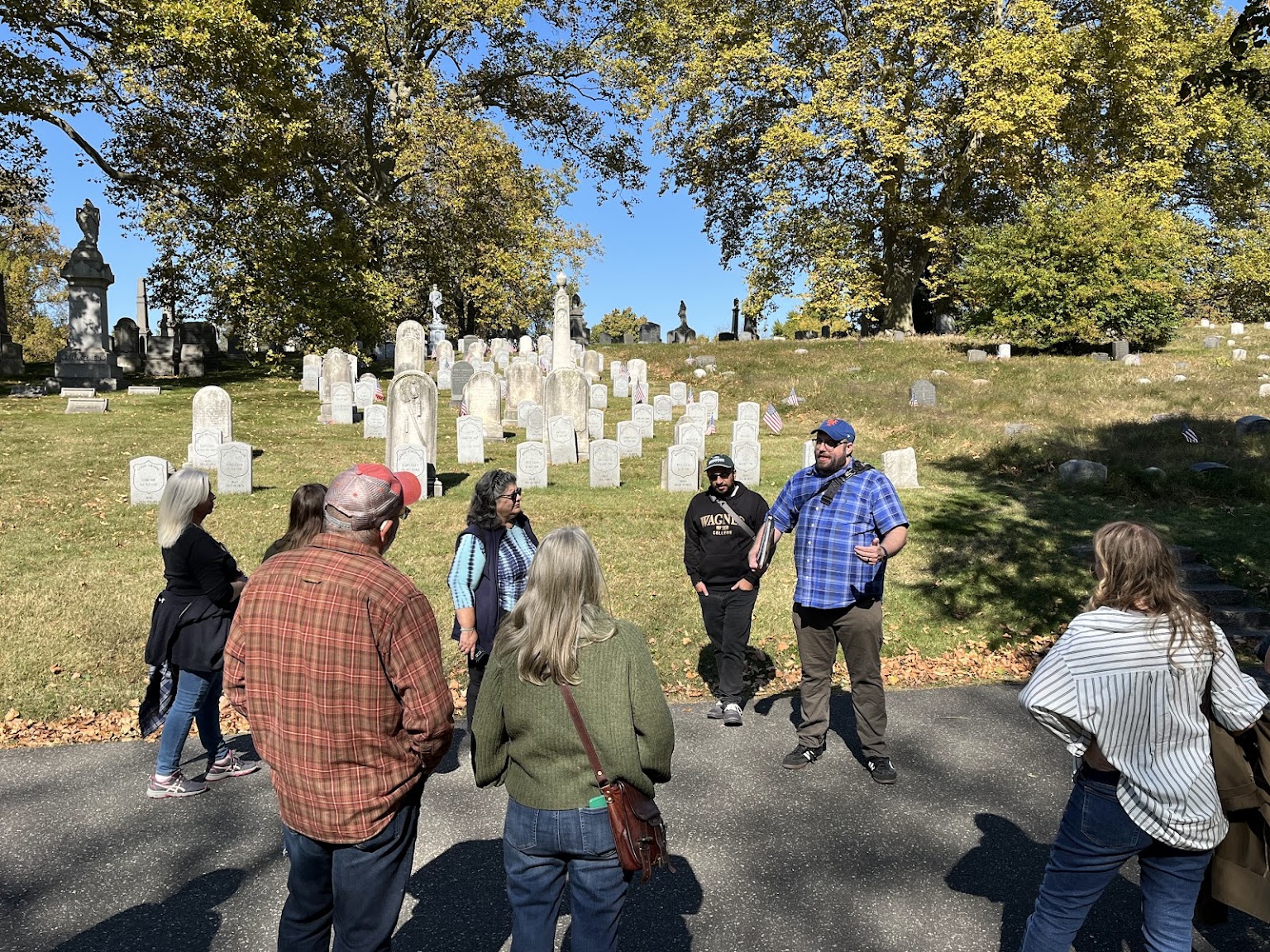
You can stroll through this 478-acre oasis on your own, but to get the most out of a visit, you should join guide James Hoffman for his Green-Wood Cemetery Tour that he hosts through Bowery Boys Walks.

I had the chance to talk to James to find out the details behind the tour and what makes Green-Wood so special.

Oakwood Avenue in the fall.

Tell us about your background and how you became a tour guide in New York?

I moved to the city about 20 years ago and quickly became a full-time tourist. I was really interested in the general history of New York, but I was also into discovering the more off-beat locations. I spent a lot of time creating self-guided historical tours for myself by foot and bike. I read a lot of classic New York history books and followed NYC-centric blogs/podcasts (including, of course, The Bowery Boys!)

Eventually, a friend who knew I was into history recommended that I watch The Cruise (a documentary on a double-decker bus tour guide called Speed Levitch). After watching the movie, I discovered you had to pass a test to be a licensed tour guide. Initially, I got my license for bragging rights and thought it would be a part-time gig. Once I started doing my first tours in 2007, I was hooked and have been doing it ever since!

James leading a tour in front of a baseball-themed grave.

Have you always been fascinated by cemeteries? And what is it about Green-Wood in particular that makes it special?

I do like all types of graveyards/cemeteries, but in particular, I’m a big fan of rural cemeteries. They’re an amazing combination of landscaped green space and history. I’ve been to a few throughout the world, and they’re always a great experience. 

I won’t list them all, but the last one I visited was Lake View Cemetery in Cleveland. I got to see the final resting places of John D. Rockefeller, James Garfield, and Ray Chapman (the only major league baseball player to die from a hit-by-pitch). Wade Memorial Chapel is amazing, and true to the name, there are indeed amazing views of Lake Erie.

Despite being one of the best-known rural cemeteries in the world, I still think Green-Wood Cemetery is grossly underappreciated. With over 600,000 interments, there are so many fascinating stories; the cemetery has unforgettable views of the harbor, and the grounds are so beautiful! 

A shout out to the Green-Wood Historic Fund for doing such a great job making the space accessible to visitors and putting on so many cool events.

Can you speak about how Green-Wood was such a vital green space in the city before the concept of public parks?

One of the biggest surprises for guests is when they find out that Green-Wood pre-dates both Central Park and Prospect Park. Green-Wood Cemetery is similar to these parks in the sense that it has a very naturalistic design, but one of its biggest influences was its incredible popularity back in the 1800s.

“These cemeteries are the only places in the country that can give an untravelled American any idea of the beauty of many of the public parks and gardens abroad. Judging from the crowds of people in carriages, and on foot, which I find constantly thronging Greenwood and Mount Auburn, I think it is plain enough how much our citizens, of all classes, would enjoy public parks on a similar scale.” – Andrew Jackson Downing – Rural Essays 

People had pushed for a large public space in New York for many years before Central Park was built. The thousands of people who visited Green-Wood every year were a huge motivation for New York (which was a separate city from Brooklyn at the time) to get the ball rolling.

Battle Hill, the highest point in Brooklyn.

One highlight of the tour is reaching the highest point in Brooklyn to see the stunning view. Can you tell us about a couple of other favorite highlights on the tour that you have?

People are always delighted by the monk parrots at the front gate. It surprises a lot of people to learn there are parrots in NYC at all, much less while visiting a cemetery. That’s in addition to all the other birds here with Red-tailed Hawks being another crowd favorite.

I tend to focus on the history of the grounds and people interred there, but I do love all the trees here in Green-Wood as well. There are hundreds of different varieties here, and depending on the weather, I sometimes show people my favorite — a beautiful weeping beech in the middle of the cemetery.

The graves of famous people are always a draw in any cemetery. Can you name a few interesting New Yorkers who are buried in Green-Wood?

So many! Boss Tweed, Chuck Close, DeWitt Clinton, Basquiat, Elizabeth Tilton, Lola Montez, Bill the Butcher, Pete Hamill… the list goes on and on. 

Often, it’s the history of the person buried at a grave site that draws you in. Sometimes the grave site itself is the draw. I have a soft spot for the grave with a recipe for spritz cookies.

The gothic revical gates at the entrance of Green-Wood Cemetery.

Beyond cemeteries, what other types of tours do you give?

I do a lot of different walking tours; Grand Central, Financial District, Central Park… a lot of the classic neighborhoods and landmarks. 

As far as specialty tours go, I do a variety of cocktail-themed tours and talks. I currently do a cocktail-themed tour of Green-Wood Cemetery that ends with cocktails connected to the grave sites seen on the tours (such as Bill the Butcher and Boss Tweed). I also will be doing a new cocktail-themed stage/burlesque/vaudeville themed cocktail tour of Green-Wood this year as well. We’ll visit Frank Morgan (The Wizard of Oz), Laura Keene (the lead actress at the performance Lincoln was assassinated at), and Lola Montez (a famous dancer and courtesan) before having theatrical-themed cocktails at a local bar.

I also do a Gilded Age cocktail walk of Madison Square and Gramercy Park and will be debuting one or two Prohibition-themed walks this year.

Bike tours are another speciality of mine, especially throughout Manhattan and Brooklyn. I’ve been doing them for over 15 years. It’s a great way to see the city and lets you go on routes that simply aren’t possible any other way. It’s really cool to take a tour group and to be able to go from Fort Greene to Prospect Park to Red Hook to the Brooklyn Bridge all in less than 3 hours.

Thanks, James! 


Do you want to stroll through Brooklyn’s most famous cemetery?

Sign up for a tour of Green-Wood with James right here.

Categories
Interviews

Looking at Art Deco Gems with Jeremy Wilcox

Did you know Art Deco turns 100 this year? This iconic design style that emerged from Paris in the 1920s has had a massive impact on the New York skyline — the Chrysler Building and the Empire State Building just to name a couple of examples.

To see this remarkable style up close on the street and inside several lobbies, you can book our Midtown Art Deco Tour: The Golden Age of the Skyscraper with guide Jeremy Wilcox.

I recently met up with Jeremy to learn more about Art Deco design and find out how he became so fascinated with it as a tour guide.

Tour guide Jeremy Wilcox in front of the Chrysler Building.

2025 marks the 100th anniversary of Art Deco. Can you give an overview of how this movement emerged in the 1920s?

Art Deco is a fascinating movement because in a way it sounds contradictory. Coming out of earlier modern styles like Art Nouveau, the idea that coalesced into “Deco” was about taking modern art and design and streamlining it: clean lines, sharp angles, geometric patterning, very industrial and sleek. And yet it is so bold, expressive, and eye-catching. So you have a “streamlined” style that is now considered the peak of bold design and architecture.

At the time, the French called it “style moderne”. But what is “modern” changes every generation, so retrospectively it got its now-famous name from the Exposition Internationale des Arts Décoratifs et Industriels Modernes, held in Paris a century ago. It was the first major global exhibition celebrating this new style and is considered by many historians to be the real birth of Deco as the dominant movement of its age.

It also perfectly captured the feeling of the “Roaring ’20s”: A modern, industrial society celebrating itself through a cohesive style that would feel timeless and forward-looking simultaneously.

[Side-note: I didn’t come up with this comparison, but an easy way to think of the difference between Nouveau and Deco is: Art Nouveau is when it looks made by elves. Art Deco is when it looks made by dwarves.]

American Radiator Building and Empire State Building

I know you are a native New Yorker but how did you become a tour guide? And what sparked your interest in Art Deco architecture?

I became a tour guide exactly 9 years ago. I love being outdoors and never really wanted a typical office job. Prior to this, I also realized that many New Yorkers take the city for granted (we’re busy!) and so began using my free time to explore the city and its landmarks, falling in love with New York really for the first time. I started dragging my friends along on my walks, and explaining what I had learned about what we were seeing. This led to the “aha!” moment of me realizing what I should do for a living.

I came into my love of architecture by walking around the city when I was younger, and at first seeing it just as a random collection of buildings. But then you start noticing similar buildings and things start to click, especially as you research them all. Architecture is how we can “read” a city. Once you learn to recognize special styles and elements, you can look at any building or neighborhood, and know the era(s) when it was developed, and what society was like at that time.

And Art Deco is the style that still defines New York. When people think of the default NYC skyscraper, they’re likely not thinking of One World Trade Center or the Central Park Tower. They’re thinking of a building from the 1920s and 1930s. That’s telling.

Your Midtown Art Deco Walking Tour is amazing. How did you come up with the route and decide which landmarks to include?

This was a hard tour to design, not because of what to include, but because of what to leave out, due to timing and logistics. I started with the understanding that the tour must include Art Deco’s crown jewel — the Chrysler Building — and designed the rest of the route around that. So I walked around thinking, “In a reasonably-paced 2.5 hours, what route makes the most logical sense, in terms of narrative and flow?”

The current version of the tour is not the original route, but it’s the one that ultimately works best in terms of maximizing the time, as well as another tour goal: Not just seeing the obvious landmarks, but some of the hidden gems.

One thing I love about the tour is that it goes into several lobbies that most people don’t even know exist. Was it hard to figure out how to pull that off?

Yes. These lobbies are generally accessible on weekdays during business hours, so I knew the tour couldn’t operate on weekends, which was somewhat limiting.

Once I knew what buildings I wanted to include, I went solo and visited each lobby, checking with security staff there to see if I could bring in groups, and what rules they had about that. The rules vary: group sizes, whether photos are allowed, and issues like that. These are private spaces, so I want to make sure we are respecting their wishes.

The other benefit of the lobby stops: You can escape from the inclement weather outside for a few minutes. For that reason, I also include a quick pass through Grand Central, even though it is not a Deco building. But Grand Central does show the contrast with other grand architectural styles.

The lobby of 500 Fifth Avenue.

What are one or two highlights of the tour that you always look forward to?

The highlights are helping guests discover those lesser-known buildings along the route. If you can show people (sometimes even New Yorkers) an amazing Deco landmark they probably walked by many times without even noticing, that’s really great.

The Chrysler Building is also always a highlight, as there are a ton of little architectural details even many fans of the building have never noticed before. I love helping people really notice the building in full for the first time.

Do you have any landmarks on your wish list to see that are not open to the public?

It’s not Art Deco, but I’m always sad that the lobby of the Woolworth Building downtown is not open to the public. It is a masterpiece.

In terms of Deco specifically, I understand the logistical reasons (it’s a working office building), but I wish the entire ground floor of the Empire State Building was accessible to visitors. Spread throughout that level, there are these beautiful medallions celebrating the technologies that made such buildings possible (electricity, masonry, heating, elevators, decoration, plumbing, excavation!). Three of them, though, can be seen in the main 5th Avenue lobby, which is usually open.

There are also a few other stunning Deco lobbies not open to the public, such as the Barclay–Vesey Building, and 60 Hudson Street (formerly the Western Union Building). Both are downtown and designed by the great architect Ralph Walker.

And too many others to name!


Do you want to see the Art Deco landmarks of Midtown up close?

Sign up for a tour with Jeremy right here.

Categories
Interviews

Tasting and Touring Chinatown with Robert Zhu

There are a lot of great neighborhoods in New York, but Chinatown has always been one of my favorites. I worked in Chinatown for several years as a guidebook editor for Not For Tourists, so I got to know all of the mom-and-pop restaurants — dumplings, noodles and dim sum every day for lunch! On top of the cuisine, the culture, architecture, and vibrant street life make Chinatown a must-see destination.

So I was very excited in March when Bowery Boys Walks launched a brand-new Chinatown tour (“Tastes of Chinatown: Neighborhood History and Food Tour”) with guide Robert Zhu that combines two of my favorite things in life — food and history.

I had the chance to sit down with Robert in between tours to find out how he came up with the content for the tour and how he chose the restaurants.

Robert Zhu on Pell Street

Give us a little background on your life in New York and how you become a tour guide.

I moved to New York City way back in 1995 and fell in love with her at my very first sight. I found New York City inspirational, inclusive, and forgiving. If one year in a dog’s life equals seven years in a human’s life, one New York City day is seven days in other cities, if not more! Under her fast-paced exciting facade, I’m fascinated with New York City’s rich history and mixture of world cultures, and I always wanted to tell her stories. So for me, being a tour guide is a dream come true.

What do you think makes Manhattan’s Chinatown so special?

Although Manhattan’s Chinatown is no longer the largest Chinese population outside of Asia — that is now Flushing Chinatown in Queens — it still has the most diverse Chinese immigrant population with many Chinese dialects spoken. It was where the railroad builders settled escaping California’s extreme discrimination back in the 1870s. It welcomed the tired, the poor and huddled Chinese immigrants despite the Chinese Exclusion Act of 1882, and today it is still the beating heart of all Chinatowns on the East Coast.

Food is probably the number one attraction of the neighborhood. How do you pick the restaurants and the dishes you want to showcase?

I ate a lot of food at many different places. I have the best research team one can hope for, it consists of me, my dad, and my mom. My parents gave me lots of insights, and I have a list of restaurants and dishes that they endorse. 

Bowery Boys fans are already loving this tour. How did you blend in the history of Chinatown with the cuisine?

Food is an integral part of any culture. Cooking and enjoying delicious meals with family and friends is a big deal in Chinese society. We discuss almost everything including social issues and personal affairs over family-style dishes. I think in this case, Anthony Bourdain is a perfect example of someone who could combine culture, history, and food. He could discuss politics and current affairs over a dish with people he met anywhere in the world. I try to do the same. 

What are a few of your favorite landmarks or streets in Chinatown? 

The intersections of Doyers, Pell, and Mott Streets, East Broadway, and of course, the Golden Noodle Pegasus. This soaring statue was put up over Pell Street where it meets Doyers Street in 2017 and is rumored to be made of dried egg noodles and handmade in Shanghai. My understanding is that it symbolizes the power of creative spirits in all of us and helps Chinatown to weather the bad times and renew itself. 

The Golden Noodle Pegasus floating above Pell Street.

If there’s one thing you want people to walk away with from your tour, what is it?

Feeling satiated — both physically and intellectually.

Finally, you only get one choice — noodles or dumplings?

It’s got to be the dumplings! 


Hungry for a tour through Chinatown yet?

Sign up for a tour with Robert right here.

Categories
Interviews

Exploring Grand Central with Beth Goffe

Grand Central Terminal is one of my favorite buildings in all of New York City. And during the holiday season, it sparkles just a little bit brighter. There’s something about walking through the main concourse with the steady flow of commuters rushing by that always gives me a jolt of inspiration — especially at this time of year. 

Someone who really knows the hidden corners and secrets of this cherished building is Beth Goffe, a tour guide who leads our wonderful Glorious Grand Central Revealed Tour

I recently sat down with Beth to chat about this legendary train station and what makes it so special to New Yorkers and visitors alike.

How did your passion develop for Grand Central Terminal that led you to be a tour guide of such an iconic landmark?

In 2001, I started a job in what was then called the Lincoln Building (now One Grand Central Place) across 42nd Street from the Terminal. Like tens of thousands of other people, I was in and out of the building all the time, usually on a mission to pick something up from one of the shops there or simply to use the subway, giving little thought to the building itself. It wasn’t until December 2020, in the middle of the COVID pandemic, that one of our prominent tour guides, Joe Svehlak, gave a comprehensive tour of the oddly quiet terminal. Joe really clued us into the building’s macro beauty and its more subtle and fascinating innovations, plus its many little secrets. It was then my love for Grand Central Terminal was kindled, and I knew it was something I had to share with others. 

What is your favorite thing about Grand Central during the holidays?

While the interior decorations there are more subtle than other city landmarks, they still reflect the warmth of the season and are especially welcoming. Grand Central really doesn’t need much to elicit joy, of course — its Beaux-Arts design inspires and uplifts throughout the year. The holiday fair in Vanderbilt Hall is a bonus that offers visitors lots of options for seasonal gift shopping – indoors!

Where is your favorite place for taking photos in the terminal?

An obvious photography location is to capture most of the concourse, including the singular painted ceiling, from the top of the staircase at either end. However, a favorite spot is from the ramps leading down to the lower concourse. The slope offers an interesting perspective and it’s possible to include the gold electroliers gracing the south side of the terminal. If you know where to look, you can also get a creative peek of the concourse ceiling. Whitney Warren of Warren and Wetmore, one of the designers, really thought of everything. 

Beth leading a tour through Grand Central Terminal.

And of course, Grand Central is now known as a foodie and shopping destination — it does have a giant Apple Store after all. Do you have any favorite places to eat, grab a coffee or shop in the terminal in between tours?

In the wake of the pandemic, the food court in the Lower Concourse was pretty empty but more and more vendors are returning now. I like Tartinery for a bite to eat or for a pastry.  Of course, there’s always the historic Oyster Bar — I recommend the clam chowder. Also downstairs is Donut Plant for creative donut flavors. After a tour, I like to run to Eli’s in Grand Central Market for the big meringue shells I enjoy for dessert. The Market offers a variety of food vendors, from fish to spices to fresh produce. Next door in the Lexington Passage is a sort of mini-mall with all kinds of mostly high-end shopping options.   

It was so much fun talking about Grand Central with you, Beth!

What about you, reader? Do you want to take a tour of Grand Central this winter to discover its secrets and hidden corners?

Take the Glorious Grand Central Terminal Tour with Beth

Sign up for a tour right here.

Categories
Interviews

An interview with Carl Raymond, host of The Gilded Gentleman History Podcast

Carl Raymond has worn many professional hats throughout his career including as one of the first tour guides for Bowery Boys Walks when the company launched in 2018. Now he is taking on a brand-new adventure as he partners with The Bowery Boys for an exciting new podcast. The Gilded Gentleman History Podcast tells the amazing stories and secrets of this grand and glittering time in America’s Gilded Age, Paris’ Belle Époque, and England’s Victorian and Edwardian eras.

We recently sat down with Carl right after he recorded a show for a chat over a pot of tea. We talked about what inspired him to enter the world of podcasting, why he finds New York’s Gilded Age so fascinating, and what it’s like working with The Bowery Boys. 

Carl Raymond (Photo by Richard Koek, logo by Georgia Morrissey)

Before we dive into the podcast, can you just tell us a little bit about your background and how you become a guide for Bowery Boys Walks? 

I’ve always loved talking about history, and I’ve done many lectures and talks over the past 10 years. I became a professional New York City tour guide in 2014 and I love actually showing people historic sites on the street, seeing it in person just makes it all really come alive. I met Tom at an event for tour guides, and we just connected and what I do and what the Bowery Boys do seemed like a good fit — and it is!

Tell us about your journey to the world of podcasting. How did you end up creating a spin-off show for The Bowery Boys? 

Creating a podcast was just a natural extension for me coming out of tours and lectures, except it’s much shorter! My style and the Bowery Boys style match each other really well and the subjects I do and the areas I cover really complement what they do as well — it was kind of a harmonic convergence.

And what is it about the Gilded Age, and specifically New York’s role in that time period, that makes such an ideal topic?

People often get swept up in the imagined glamour of the Gilded Age and that was certainly an element of the time, but there was so much more. I want to take listeners to areas and introduce people that they may have never knew existed. As for New York, that end of the 19th century period was the time when the modern city was being built and evolving so quickly — it was such an exciting time to talk about — and in some ways has not changed so much today. 

There are new podcasts debuting all the time. What makes your podcast stand out from the crowd?

I think any good podcast consists of two things — content that intrigues people and makes them come away with hopefully one thing they never knew or something they want to explore on their own. I certainly try to do that. And perhaps the most important part of a good show is the personality of the host or hosts. I try to be fun, engaging and offer a 30-minute break that people will want to come back to every two weeks!

Carl and The Bowery Boys, Tom Meyers & Greg Young recording at the Salmagundi Club. (Photo by Craig Nelson)

What is it like working with the Bowery Boys and being part of their media company now? 

Tom and Greg are the most wonderful collaborators. They have had so much experience creating and producing content that I’ve been lucky to have their expertise help shape The Gilded Gentleman. What I do and what interests me naturally complements what they do and what interests them — that’s what makes it work. The best part is that we all have the same great sense of humor. It’s exciting because now with both of our shows, it will help Bowery Boys Media expand into some new areas for all of us.

Finally, do you still plan on doing tours, talks, and special events alongside the podcast?

Oh, absolutely! A podcast is just another piece of the brand of The Gilded Gentleman and the brand of me! It’s like creating a number of puzzle pieces to fit together — they are all slightly different, but they all fit together in the end. Each item whether it is a tour, talk, or podcast episode is a unique way to get to different audiences and offer them different experiences.  In fact, I have a special live virtual event coming up on January 20th about Edith Wharton!

Subscribe and listen to The Gilded Gentleman

Carl’s history podcast is live now! New episodes are released every two weeks. Subscribe on Apple or with your favorite podcast player and keep an eye on Bowery Boys Walks for upcoming events with The Gilded Gentleman.

Categories
Interviews

A very special Brooklyn Bridge tour: An interview with Kriss Roebling

The Bowery Boys are very excited to launch their newest New York walking tour: a Brooklyn Bridge walk with Kriss Roebling, the great great grandson of Washington and Emily Roebling, the famous builders of the world’s most iconic bridge.

We recently had a chance to explore the Brooklyn Bridge with Kriss and see some of the rare artifacts from his family collection. After taking the tour, we can assure you that you are in for a treat!

We also had a chance to talk about his special family connection to the bridge, what inspired him to start giving tours, and why he loves the Bowery Boys podcast.


Interview with Kriss Roebling

What was it like to grow up as a Roebling knowing your family’s intimate history with the Brooklyn Bridge?

It was nice to have a familial connection to the builders of the Brooklyn Bridge, and to their amazing story, but my parents (who were in the arts) also emphasized the importance of one’s own creative output and the contributions one makes to the world in one’s own lifetime. I guess you could say that I was proud of my family history, yet careful not to lose my own identity to that history.

What is your first memory of the bridge?

It was a children’s storybook that I was given which was about the building of the Brooklyn Bridge. I loved that book and read it over and over again. I remember the illustrations of the Brooklyn Bridge in that book even before I remember seeing the Brooklyn Bridge in person.

What inspired you to learn more about your family history and great great grandparents?

I’m not sure if I have ever tried to learn about my family history than I simply absorbed it naturally and without effort over the years. I think of myself more as a witness to that history as it has been handed down to me rather than a scholar of our history or even as a tour guide. I simply remember what I was told at the dinner table very, very well.

That said, as it became clear that people really enjoyed how I told my family’s stories, and I was inspired to perfect my presentation. I love how much the stories excite and please people, so I’ve done my best over the past three decades to learn how to tell them in the most compelling and elucidating way possible. It’s the joy that these stories give other people that make this Brooklyn Bridge walk such a pleasure for me.

How did you start giving tours of the Bridge?

About 30 years ago, I started giving these walks for friends and family who visited from out of town. The word got out that I did these walks, and so friends started asking me if I could do my Brooklyn Bridge walk for their friends — and so on and so on until I was doing my Brooklyn Bridge walks for complete strangers. Sometimes I couldn’t even determine how I knew the people whom I did my walks for, that’s how many degrees of separation there were after a while! 

Also, I sometimes enjoyed walking up to random people on the Brooklyn Bridge and offering them a surprise experience such as what I would offer my friends, but that rarely worked out well. Everybody always thought that I was trying to con them in some way.


Book online now!

Kriss showing a Tom Meyers of the Bowery Boys a bolt from the Brooklyn Bridge.

What’s your favorite Bowery Boys podcast episode?

Oh God, there are so many that I don’t know where to start! I was introduced to their podcasts only about a year ago, so I still have a lot of catching up to do, but for a lover of New York City history, their podcast is true ear candy.

There’s something about learning what happened previously where you stand in the here and now which adds such three-dimensionality to one’s world. I love learning about what made my surroundings into my surroundings. The Bowery Boys certainly satisfy that craving.

That said, to get specific, the Roosevelt Island episode stands out in my memory, as does episode #29 on the Brooklyn Bridge. Great, great stuff!!

What makes your Brooklyn Bridge tour with the Bowery Boys stand out?

Well, as I mentioned, I’m not a tour guide so much as a witness to my own family’s oral history. As such, I can provide a slant on that family history which is unique, because it is imbued with the interpretations, asides, and gossip that only comes from being in the family. Then I underscore my stories by sharing relics and artifacts that are relevant. I like to think that I give people an opportunity to come face-to-face with the bridge’s history rather than just get the “official story”.

What are some of your favorite places in NYC (other than the Brooklyn Bridge)?

Although it has become quite gentrified since I started hanging out there in the early 1980s, DUMBO is still a stunning neighborhood. It is a beautifully preserved 19th-century industrial relic that’s been re-purposed for living, dining, and general revelry. It’s also surrounded by water on three sides, so there is a distinct sense of it’s natural setting and marine culture, this being underscored by ship horns, seagulls, primordial river banks, and the ruins of maritime industries. Also, being a nubby peninsula of sorts, there is no real traffic in this neighborhood. People don’t drive through DUMBO, they go there, so traffic is calm for the most part.

I also love Breezy Point Tip. It’s difficult to get to, but it’s worth the effort. You feel as if you are on some deserted beach (except during high fishing season), then you round the “tip”, and there you are face-to-face with New York Harbor! It’s a very cool place.

John Roebling’s original drafting tools.

Join Kriss on the Bridge!

Do you want to take this one-of-a-kind Brooklyn Bridge walking tour with a relative of the famous Roebling family? Get your tickets to our very special Brooklyn Bridge History Tour with Kriss Roebling.


Book online now!